When Synergy Sports tries to classify the offensive roles of different players • Basketball USA
“I no longer believe that there are five positions. I think we can simplify things now to three positions: ball carrier, wing and interior. This is very important. Players have become more versatile as the game has evolved.”
 It’s been a few years since Brad Stevens uttered this line and we can say that the Celtics president defined things well, positions are just mental anchors anywaywhose definitions undoubtedly need to be reexamined.
In two articles on Synergy Sports, Todd Whitehead elaborates how he used different statistics to try to classify the different players in the league.
6 tasks for 11 attacking roles
The idea is to determine how well basketball players perform the following six tasks:
– Hold the ball
– Create advantages
– Use defensive rotations, i.e. “hold the lead”
– Score (close to the circle or on 3 points)
– Space the field, with a screen, a cut, his ability to draw the defense…
– Position yourself, that is, position yourself and catch the ball in different places on the field
Depending on the frequency with which players perform these different tasks, Sinergi Sports has defined 11 profiles, grouped into three categories. So there are “ball carriers”divided into three subcategories: “creative ball carriers”, “secondary ball carriers” and “goal ball carriers”.
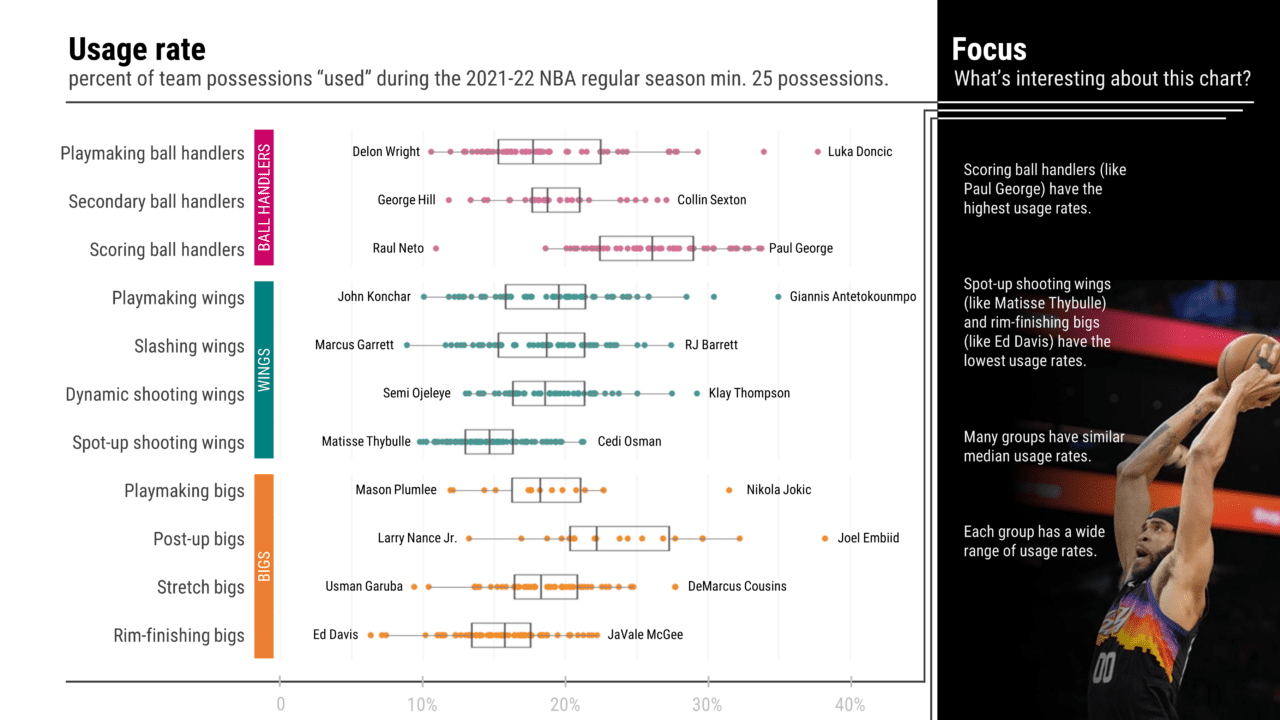
Thus, for the data from the 2021/22 season (minimum 25 possessions), Luka Dončić is the “creative ball carrier” with the highest usage rate, Colin Sexton is an example of a “secondary ball carrier”, and Paul George is an example of “scoring the ball”. holder”.
After the “ball carrier”, there are “wings”which are themselves divided into four sub-categories: “creative wings”, “cutting wings”, “dynamic shooting wings” and “catch and shoot wings”. Giannis Antetokounmpo is the most prominent example of the first subcategory, while RJ Barrett is part of the second, Klay Thompson is part of the third and Cedi Osman is part of the fourth.
Finally, there are “inside”. And here there are four subcategories with “creative interiors”, “low post playing interior”, “play widening interior” and “circle finishing interior”. As expected, Nikola Jokic is a prime example of the first subcategory, and Jole Embiid of the second. DeMarcus Cousins best defined the third subcategory last year, while JaVale McGee is in the fourth subcategory.
Nothing revolutionary, in the end. But it is interesting to note the use of objective criteria to try to define the roles of each player.
?new feature coming ?
offensive roles based on a player’s game type and shot type mix? pic.tvitter.com/rVODvGHVkd— Todd Whitehead (@CrumpledJumper) March 16, 2023
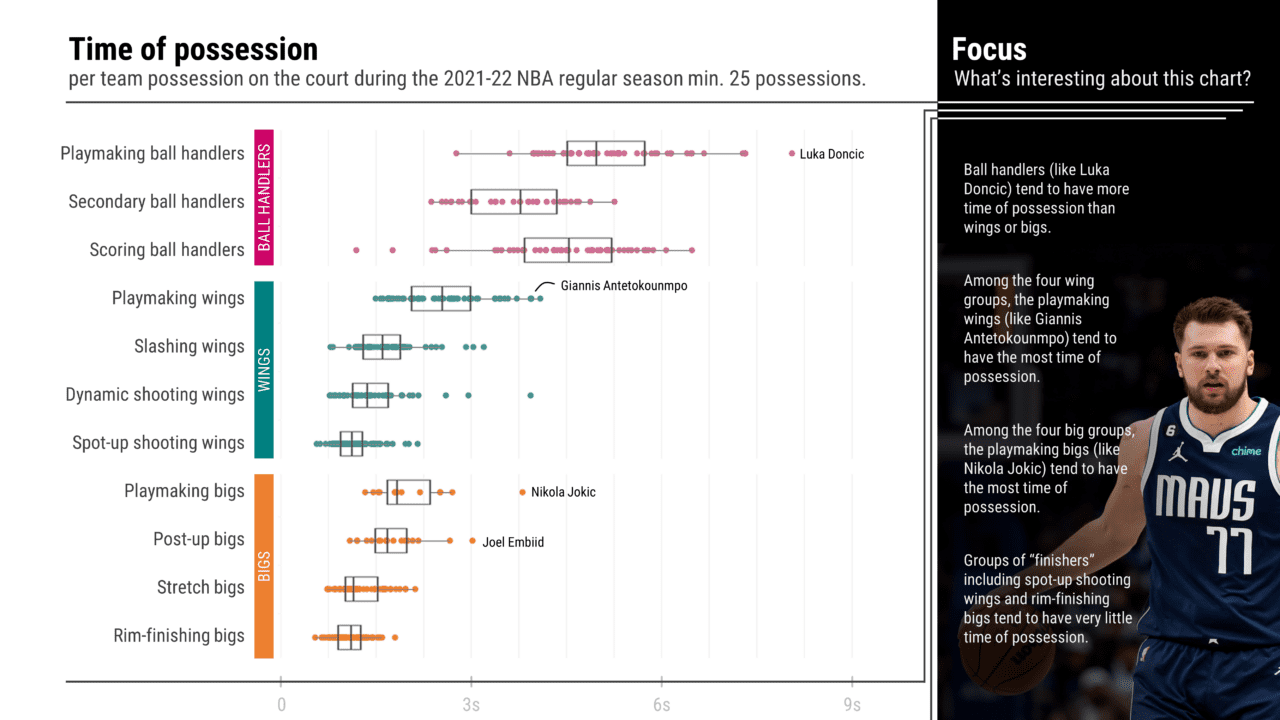
Thus, the “carriers of the ball” are logically defined by a very significant “time possession” of the ball, with Luka Dončić at the top, last year, the Slovenian had the ball for almost 8 seconds per attack.
Define in a simple and intuitive way
Threes in the corners are also an interesting marker.
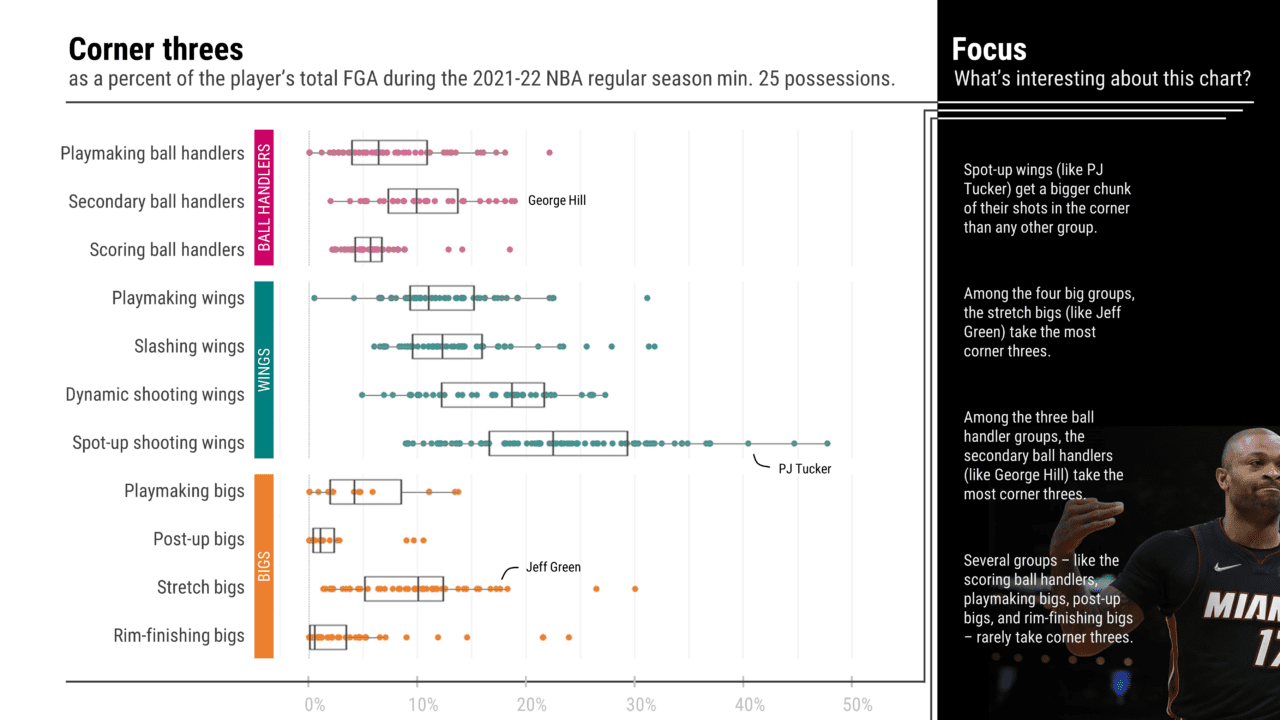
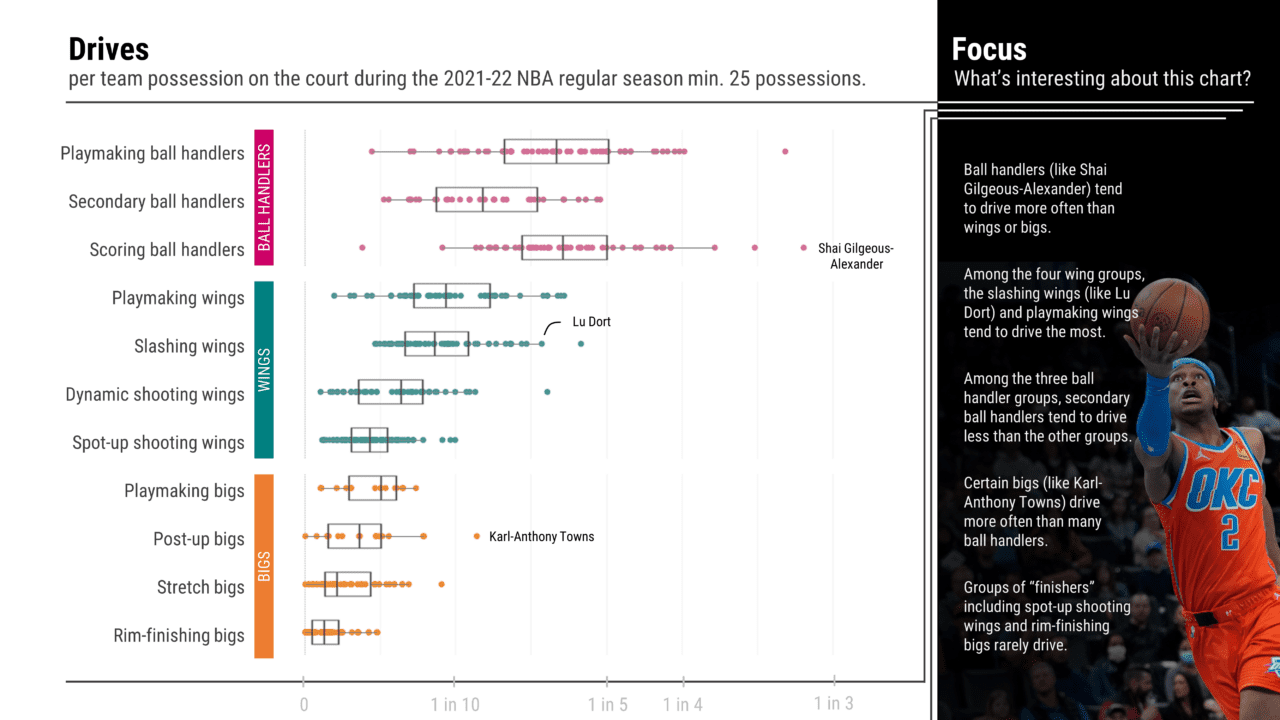
So is the penetration rate, with Shai Gilgeous-Alexander specifically attacking the rim about a third of the time, and Lou Dort doing it a lot as well. It has to be said that, in general, the Thunder’s offensive game relies heavily on these perimeter attacks.
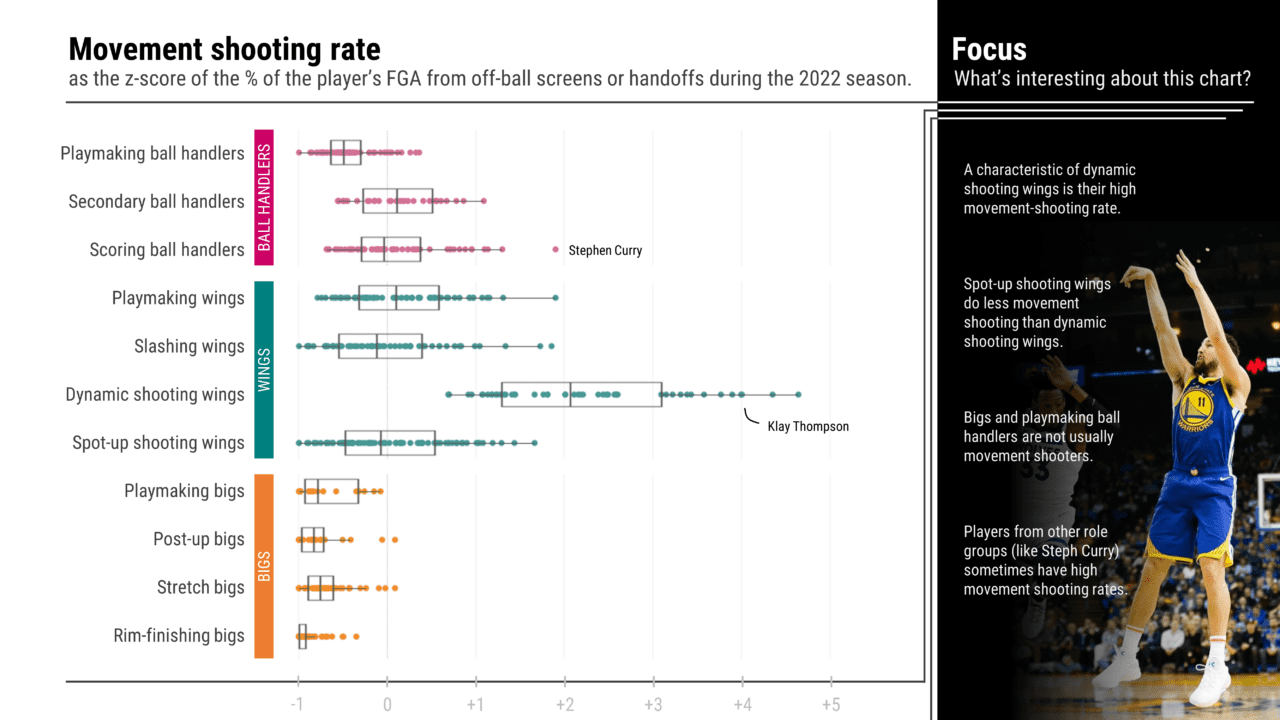
The movement of the shooters (use of screens without the ball and hand to hand) is also interesting, even if Todd Whitehead explains that it is a bit biased because this movement is one of the factors in defining positions.
As the latter explains, the goal of this nomenclature is ultimately primarily to allow coaches and scouts to simply and intuitively define players’ offensive roles. You just have to do the same job defensively…
2023-03-26 15:03:00