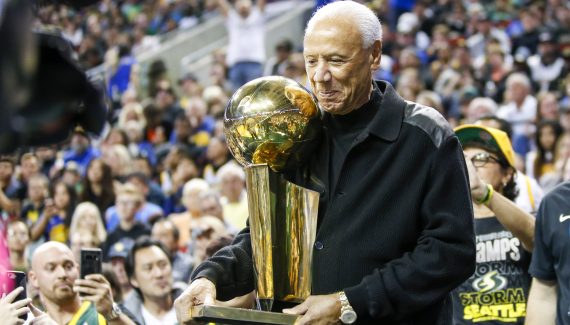
Lenny Wilkens, the ‘Godfather of Basketball’ from Seattle, has passed away
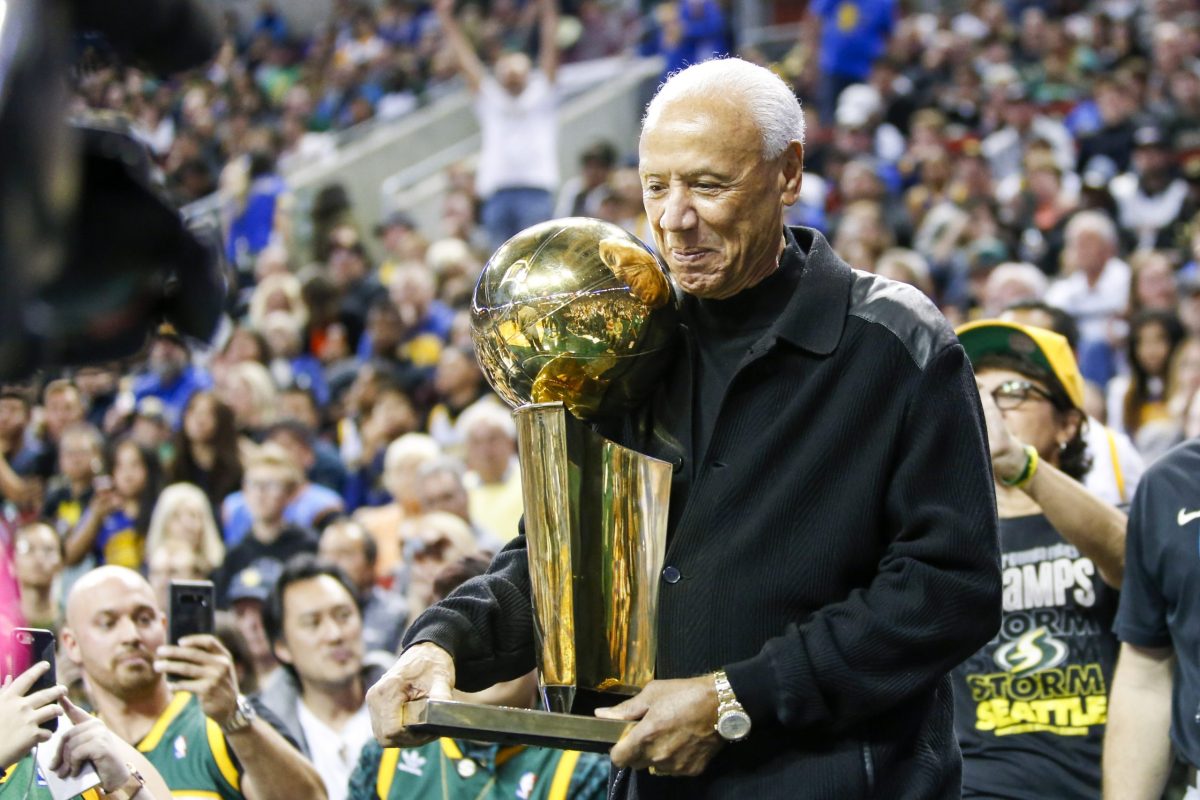 That’s all Seattle who is in mourning. The city has lost one of its greatest ambassadors: Lenny Wilkenslocally nicknamed “The Godfather of Basketball”. The former player and coach passed away this week, at the age of 88. He celebrated his birthday just a few weeks ago, and last June he became the first person to have a statue installed near the Climate Pledge Arena.
A true icon of the Seattle SuperSonics, Lenny Wilkens will forever mark the franchise. A player from 1968 to 1972, then a coach for eleven seasons (1969-72 and 1977-85), he will especially go down in history as the architect of the franchise’s only NBA title, won in 1979.
That year, he led the gang of Dennis Johnson, Jack Sikma and Gus Williams to the top, dominating the Washington Bullets (4-1). Brilliant revenge after losing in the final a year earlier.
« Lenny Wilkens embodied the best of the NBA, as a Hall of Fame player, Hall of Fame coach and one of the sport’s most respected ambassadors » said Adam Silver to honor him. ” So much so that four years ago he received the unique honor of being named both in the Top 75 best players and in the Top 15 best coaches in history. »
Great player, become an even better coach
Like John Wooden, Tommy Heinsohn, Bill Sharman and Bill Russell, Wilkens is part of a very select circle of men who have been inducted into the Hall of Fame twice — first as a player (1989), then as a coach (1998).
He would even be honored a third time for his role as an assistant in the legendary 1992 Dream Team.
On the court (1960-75), he wore the colors of the Hawks, Cavaliers, Trail Blazers and of course the SuperSonics, where he sometimes took on the dual role of player-coach.
A nine-time All-Star (1971 All-Star Game MVP) and second in 1968 MVP voting behind Wilt Chamberlain, he finished his career with career averages of 16.5 points, 6.7 assists, 4.7 rebounds and 1.3 steals. The league’s best passer in 1970, he is therefore among the 76 greatest players in history.
As a coach (1969-2005), Lenny Wilkens managed Atlanta, Cleveland, Portland, Toronto and New York, in addition to his stints in Seattle. In 1994, he was named “Coach of the Year” with the Hawks and also coached Team USA in 1996, winning Olympic gold in Atlanta with “Dream Team III.”
Jerry West from Seattle
In Seattle, Lenny Wilkens is more than a name: he’s a symbol. “He is to the Supersonics what Jerry West is to the Lakers”Nate McMillan confided. After settling permanently in the region, he became deeply involved in the community, working for education and youth, true to his image as a sporting gentleman.
« Even more impressive than Lenny’s accomplishments on the field is his dedication to serving others. Especially in his hometown, Seattle, where a statue was erected in his honor. He influenced the lives of countless young people, as well as generations of players and coaches, who saw in him not only a great teammate or coach, but also an outstanding mentor, driven by honesty and true class. added Adam Silver.
The third most successful coach in history with 1,332 victories, Lenny Wilkens remains the record holder for the number of games played in the NBA (2,487). He also chaired the Association of Coaches for 17 years.
| Lenny Wilkens | Percentage | Rebounds | |||||||||||||
|---|---|---|---|---|---|---|---|---|---|---|---|---|---|---|---|
| Saison | The team | MJ | Min | Shots | 3pts | LF | Off | Def | That | Pd | Ft | Int | Bp | Ct | Pts |
| 1960-61 | STH | 75 | 25 | 42.5 | 71.3 | 0.0 | 0.0 | 4.5 | 2.0 | 2.0 | 0.0 | 0.0 | 0.0 | 11.7 | |
| 1961-62 | STH | 20 | 44 | 38.5 | 76.4 | 0.0 | 0.0 | 6.6 | 5.0 | 3.0 | 0.0 | 0.0 | 0.0 | 18.2 | |
| 1962-63 | STH | 75 | 34 | 39.9 | 69.6 | 0.0 | 0.0 | 5.4 | 5.0 | 3.0 | 0.0 | 0.0 | 0.0 | 11.8 | |
| 1963-64 | STH | 78 | 32 | 41.3 | 74.0 | 0.0 | 0.0 | 4.3 | 4.0 | 3.0 | 0.0 | 0.0 | 0.0 | 12.0 | |
| 1964-65 | STH | 78 | 37 | 41.4 | 74.6 | 0.0 | 0.0 | 4.7 | 5.0 | 3.0 | 0.0 | 0.0 | 0.0 | 16.5 | |
| 1965-66 | STH | 69 | 39 | 43.1 | 79.3 | 0.0 | 0.0 | 4.7 | 6.0 | 3.0 | 0.0 | 0.0 | 0.0 | 18.0 | |
| 1966-67 | STH | 78 | 38 | 43.2 | 78.7 | 0.0 | 0.0 | 5.3 | 5.0 | 3.0 | 0.0 | 0.0 | 0.0 | 17.4 | |
| 1967-68 | STH | 82 | 39 | 43.8 | 76.8 | 0.0 | 0.0 | 5.3 | 8.0 | 3.0 | 0.0 | 0.0 | 0.0 | 20.0 | |
| 1968-69 | SEA | 82 | 42 | 44.0 | 77.0 | 0.0 | 0.0 | 6.2 | 8.0 | 3.0 | 0.0 | 0.0 | 0.0 | 22.4 | |
| 1969-70 | SEA | 75 | 37 | 42.0 | 78.8 | 0.0 | 0.0 | 5.0 | 9.0 | 2.0 | 0.0 | 0.0 | 0.0 | 17.8 | |
| 1970-71 | SEA | 71 | 37 | 41.9 | 80.3 | 0.0 | 0.0 | 4.5 | 9.0 | 2.0 | 0.0 | 0.0 | 0.0 | 19.8 | |
| 1971-72 | SEA | 80 | 37 | 46.6 | 77.4 | 0.0 | 0.0 | 4.2 | 9.0 | 2.0 | 0.0 | 0.0 | 0.0 | 18.0 | |
| 1972-73 | CLE | 75 | 40 | 44.9 | 82.8 | 0.0 | 0.0 | 4.6 | 8.0 | 2.0 | 0.0 | 0.0 | 0.0 | 20.5 | |
| 1973-74 | CLE | 74 | 34 | 46.5 | 80.1 | 1.0 | 2.0 | 3.7 | 7.0 | 2.0 | 1.0 | 0.0 | 0.0 | 16.4 | |
| 1974-75 | BI | 65 | 18 | 43.9 | 76.8 | 0.0 | 1.0 | 1.9 | 3.0 | 1.0 | 1.0 | 0.0 | 0.0 | 6.5 | |
| In total | 1077 | 35 | 43.2 | 77.4 | 0.0 | 2.0 | 4.7 | 6.0 | 3.0 | 1.0 | 0.0 | 0.0 | 16.5 | ||
How to read statistics? MJ = matches played; Min = Minute; Shots = Shots Successful / Shots Attempted; 3 points = 3 points / attempt 3 points; LF = free throws made / free throws attempted; Off = offensive rebound; Def=defensive jump; Tot = Total number of jumps; Pd = assists; Fte: Personal mistakes; Int = intercepts; Bp = lost balls; Ct: Against; Points = Points.
2025-11-10 06:29:00